
/media/yb1hzkd0/pexels-airin-party-252379-767240.jpg

African Union Soil Observatory (AUSO)

Ongoing

Africa

Soil information systems

/media/cujdjhp0/thaisa-van-der-woude.png

Thaïsa van der Woude,

Project lead

Project start
2025
Project end
2030

Africa's soils are in crisis, with widespread degradation threatening agricultural productivity, biodiversity, and water regulation. Unsustainable farming practices, climate change, and population growth exacerbate this issue, leading to reduced crop yields, food insecurity, and economic hardship for millions. Women and youth are particularly affected, facing increased workloads and limited educational and economic opportunities. Addressing these challenges requires accurate and accessible soil health data, which is often unavailable or hard to obtain across the continent. This hampers policymakers and researchers in monitoring soil conditions, tracking changes, and implementing targeted interventions.

The AUSO project aims to tackle these issues by establishing a continental African Union Soil Observatory (AUSO), which includes an African Soil Data Center (ASDAC) and a Soil Health Dashboard to fill existing data gaps. Managed by the Forum for Agricultural Research in Africa (FARA) and owned by the African Union Commission, the AUSO will consolidate soil data from various national and international sources, creating a user-friendly platform for soil health monitoring. Through efforts to address data shortages and develop national soil health strategies in 12 countries, AUSO will support stakeholders in the public and private sectors to make informed decisions, prioritise interventions, and support evidence-based soil and land management policies that promote sustainable agriculture.

AUSO will build on the Soils4Africa Soil Information System and draw insights from the European Union Soil Observatory (EUSO) and other initiatives, ensuring relevance and adaptability to the African context. The project will adopt a co-development approach, engaging stakeholders from national agricultural institutes, government departments, and other key organisations.
Objectives

  1. Sustainability plan for AUSO

    To establish a robust, user-centered foundation and enabling environment that develops, integrates and manages AUSO within the African Union system, supported by a sustainability plan for resource mobilisation and a strategic roadmap to track and assess the impact of various policy instruments on soil health. (WP2)

  2. Soil health status framework

    To develop a novel, scalable framework that describes and maps the soil health status using identified variable descriptors (indicators and interpretive metrics) and interpretive thresholds. This framework supports continental soil degradation convergence of evidence mapping, ensures fitness for purpose at national and local levels, and serves to inform stakeholders about soil health status. (WP3)

  3. African Union Soil Observatory and African Soil Data Centre

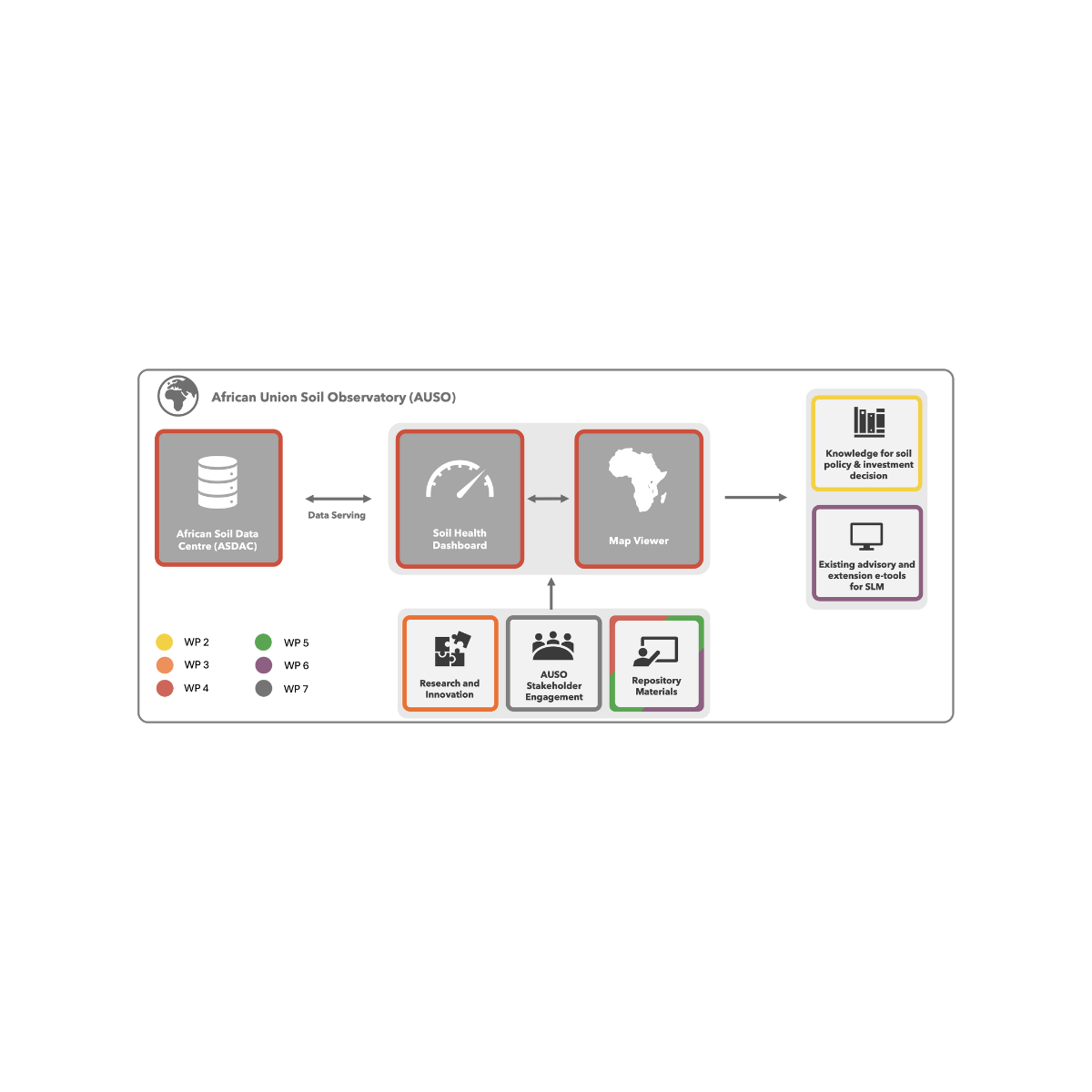
    To create an African Union Soil Observatory (AUSO) that includes an African Soil Data Centre (ASDAC) connected to the national soil health databases of 12 African countries. This system features a map-viewer including ‘convergence of evidence maps’ and soil health dashboard for visualising soil health status. (WP4)

  4. Strategic data collection

    To establish a framework for strategic data collection on key soil health descriptors to inform knowledge gaps on soil pollution, compaction, and soil biodiversity. This will be added to the AUSO dashboard and integrated in the ‘convergence of evidence’ maps. Additionally, strengthen NARIs by training national field data collection teams in sampling and in managing strategic soil health data. (WP5)

  5. National soil health strategies

    To support participating African national partners in developing national soil health strategies for better management of soil resources in agriculture and environment sustainability. Additionally, strengthen the capacity of national stakeholders on the interpretation and use of soil health data. (WP6)

  6. Soil literacy and stakeholder engagement

    To develop an engagement and communication plan and enhance soil literacy among the public. (WP7)

/media/gjzfj50k/auso-2.png
The result of the African Union Soil Observatory (AUSO) with its components. ©ISRIC.

Activities

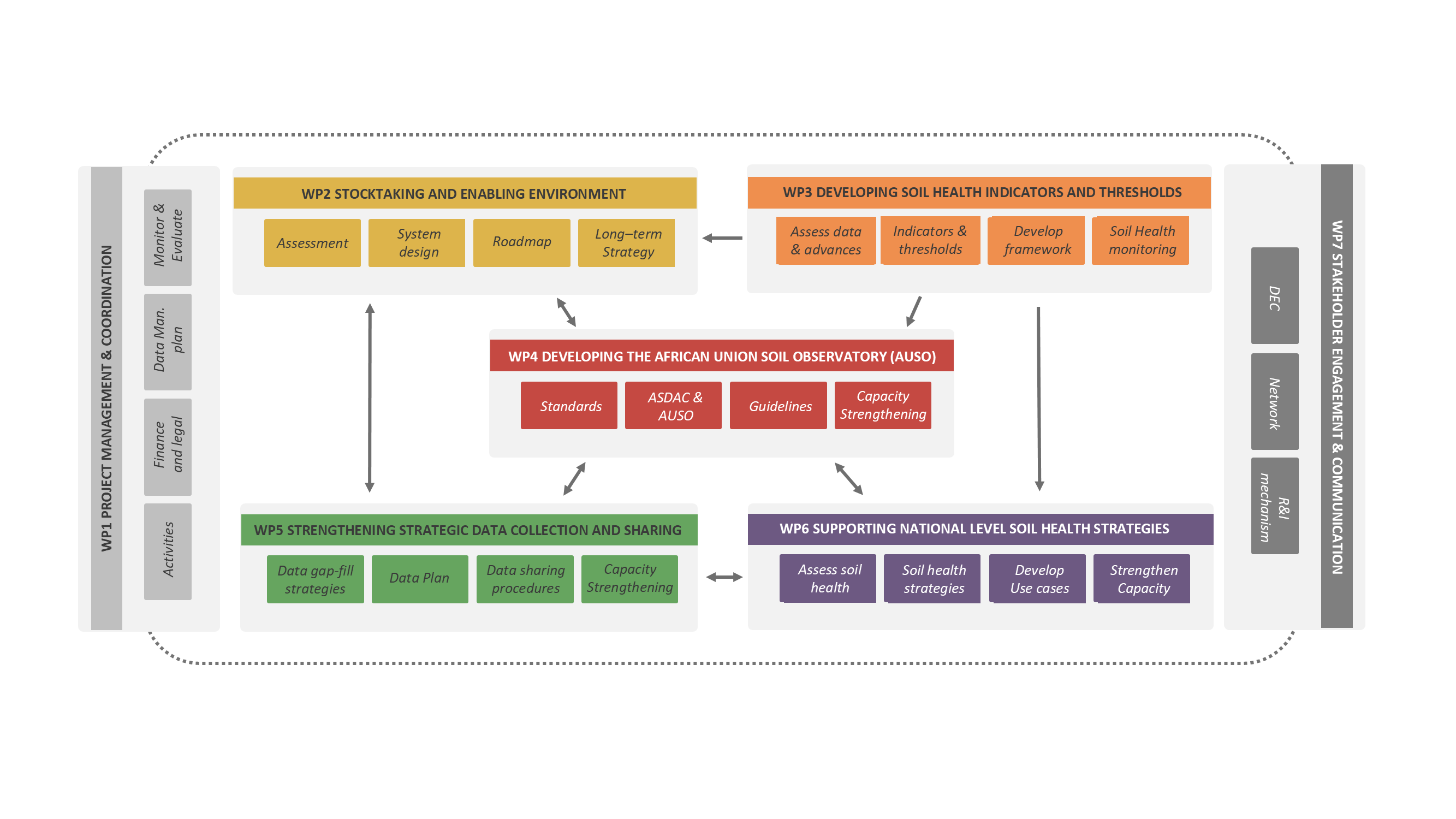
The AUSO project will be implemented through seven work packages (WP). WP 1, led by FARA, focuses on project management. WP 2, 3, and 4 are dedicated to developing the African Union Soil Observatory (AUSO) at the continental level, with stocktaking in WP2, soil health indicators in WP3, and developing AUSO in WP4. National-level efforts include strengthening data collection in WP 5 and developing national soil health strategies in WP6. WP7 covers stakeholder engagement and communication across all levels.

/media/jn4jaab4/workpackage_2.png
Relations and dependencies between work-packages. ©ISRIC.

Deliverables

  • KPI 1.1: A long-term sustainability plan for AUSO is developed and approved by the African Union by 2030.

  • KPI 1.2: A continental roadmap for tracking policy impacts on soil health is developed by 2029.

  • KPI 2.1: A scalable framework for soil health status mapping, with validated thresholds, is developed and operational by 2027.

  • KPI 3.1: AUSO and ASDAC are fully functional, hosting and integrating national soil health data from at least 12 African countries by 2030.

  • KPI 4.1: Soil health data is strategically collected at national level, with 500 locations per country, and analysed in at least 8 African countries by 2030.

  • KPI 4.2: The collected data is integrated into AUSO and contributes to a refined soil health dashboard and "convergence of evidence" maps by 2030.

  • KPI 5.1: National soil health strategies are formulated and adopted in at least 12 African countries by 2030.

  • KPI 5.2: At least three national training workshops are conducted to build the capacity of stakeholders on interpreting and using soil health data by 2030.

  • KPI 6.1: A stakeholder engagement and communication plan is developed and implemented, ensuring continuous participation throughout the project duration.

Consortium

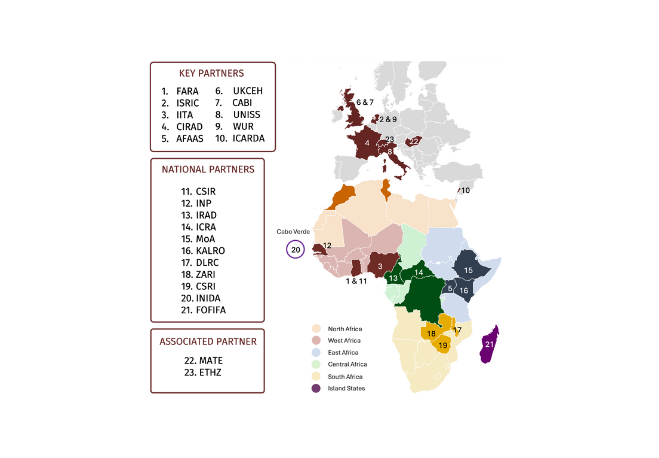
The AUSO is being developed under the leadership of the Forum for Agricultural Research in Africa (FARA) in collaboration with 23 consortium partners—more than half of whom are based in Africa. Furthermore, three additional countries will join the project at a later stage: Morocco, Tunisia, and the DRC.

/media/ozfh4hlw/map-auso.png
Project partner’s overview. ©ISRIC.

Partners include:

/media/1mbgoiro/forum_for_agricultural_research_in_africa_logo-1.png
/media/sbeastdv/logo.svg
/media/b1ldag0c/iita_taa_50_380_2.png
/media/orkfbnkp/cirad.png
/media/h0bo3k3g/afaas_logo_new.png
/media/j0ynsl03/ukceh_logo_long_720x170_rgb.png
/media/qyyd55eb/cabi-logo-png_seeklogo-497065.png
/media/kqafdp1z/universita_di_sassari.png
/media/kijpjqbl/logo-wur.png
/media/5ehcv5gz/340-3408957_icarda-logo-hd-png-download.png
/media/ba4gyalg/csir_logo-original.png
/media/mcdle4lf/institut-national-podologie.png
/media/hndhbg5q/irad.jpg
/media/enplekqt/icra.jpg
/media/5mmjqygr/moa-ethiopia-logo-1024x688.png
/media/2zdpyeqc/kenya-agricultural-and-livestock-research-institute-kalro.webp
/media/dzpfcvyv/ministry-malawi.png
/media/ezje1jbe/zari.png
/media/w1ekytb4/dr-ss-department-of-research-and-specialist-services-577464.jpg
/media/y3ndqwxj/inida.png
/media/x3ocm4hm/fofifa_logopng.png
/media/satdaxpe/mate_version02_2021_green.png
/media/0tnfw1ij/eth-zurich-logo-png_seeklogo-472961.png

Funding

This project has received funding from the EU Horizon 2020, under Grant Agreement, 101218840. The AUSO project is one of the projects funded from the Mission Soil initiative of the EU.

/media/inbpphqg/auso-logo-final-1.png
/media/4lahdpqt/logo-funded-by-eu.png

Suggested content

Share