
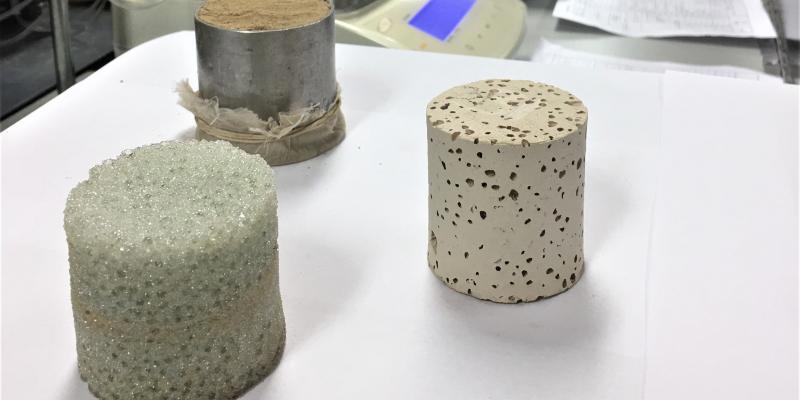


Soil is made of mineral and organic matter, but between those materials are many spaces, pores, where water flows underground. The water in those pores does important work, especially for plant growth by providing the moisture plants need and carrying nutrients to roots. Water also moves compounds such as pesticides and antibiotics through the soil, which can have serious impacts on the health of the environment. For all of these reasons, it is important to accurately measure how water moves through the soil, or soil hydro-physics.
On January 20, 2022, the Annual Meeting of the Soil Program on Hydro-Physics via International Engagement (SOPHIE) was held at the Institut de Recherche pour le Développement (IRD), in Bondy, France. ISRIC guest researcher Ad van Oostrum together with Gerben Bakker of Wageningen Environmental Research, presented results from a joint research project on designing porous reference samples for calibrating water retention curve measurements. Current methods for calibrating water retention curves need further standardization. These new samples presented by Ad and Gerben with known porosities are meant to be used as control samples in hydro-physical models of soils and inter-laboratory testing of methods as explained in their presentation.
“We designed solid samples with known porosity that can be repeatedly used and without risk for damage,” said Ad. “Compared to regular cores which can only be analysed once, these are a promising way to enhance quality of hydro-physical soil data.” The control samples are made from glass beads as well as clay.